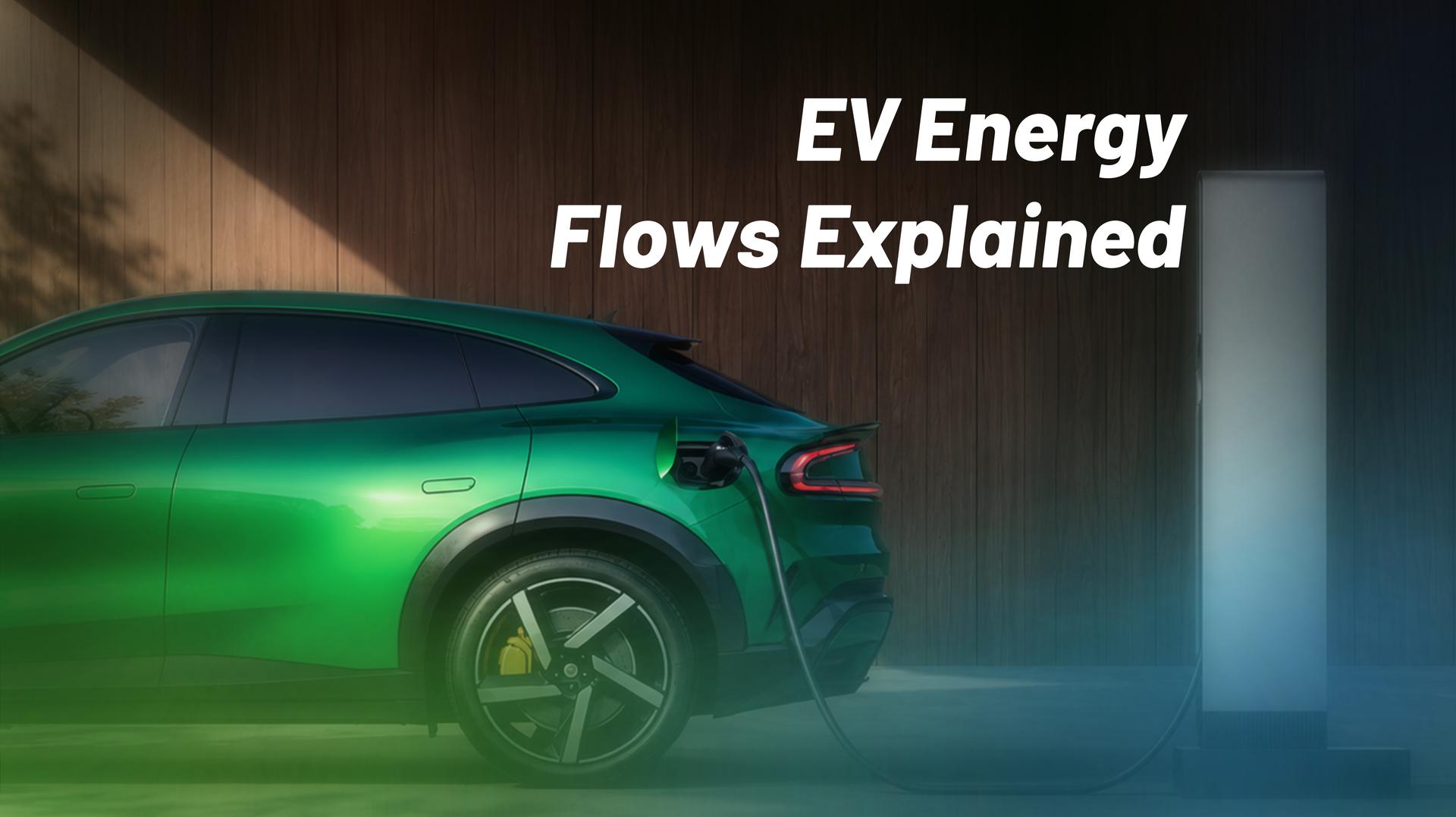
Electric vehicles are increasingly becoming part of the wider energy system.
At the simplest level, an EV is an electrical load: it connects to a charger, receives electricity and stores that energy in its battery. But advances in smart and bidirectional charging are creating new ways for vehicles to interact with homes, commercial buildings and electricity networks.
This has introduced a growing set of terms: V1G, V2G, V2B and V2H.
Although they sound similar, each describes a different relationship between the electric vehicle and the energy system around it. Understanding these distinctions is becoming increasingly important as organisations plan EV charging infrastructure, fleet electrification and future energy-management strategies.
V1G: Smart Charging Without Reverse Power Flow
V1G, sometimes called managed or smart charging, is the most straightforward form of intelligent EV charging.
Electricity still moves in one direction:
Grid → Charger → Vehicle
What changes is when and how quickly the vehicle charges.
Charging software can adjust the charging schedule or power level according to factors such as electricity demand, tariffs, available site capacity or the time by which the vehicle needs to be ready.
For example, instead of every vehicle charging at maximum power immediately when connected, a fleet depot could spread charging across the available window.
The International Energy Agency explains that V1G can modulate charging power to better align electricity demand with generation or help alleviate grid congestion.
V1G therefore introduces flexibility without requiring electricity to flow out of the EV battery.
Esyasoft's published Charging & Energy Management capabilities include smart charging, load management, tariff optimisation, energy visibility and grid-synchronised charging operations.
V2G: Vehicle-to-Grid
Vehicle-to-Grid, or V2G, takes EV energy management one step further.
Energy can move in both directions:
Grid ⇄ Vehicle
A compatible electric vehicle can charge from the electricity network and, when appropriate, return a controlled amount of stored energy to the grid.
This means the EV can move from being purely an electricity consumer to becoming a potential source of energy flexibility.
V2G may support applications such as peak-demand management, grid balancing and certain ancillary services. The IEA notes that bidirectional charging can allow EV batteries to provide grid-stabilisation services, although widespread deployment still depends on compatible vehicles and chargers, interoperable communications, regulation and suitable financial incentives.
Unlike V1G, V2G therefore requires both technical capability for reverse power flow and coordination with the electricity system.
V2H: Vehicle-to-Home
Vehicle-to-Home, or V2H, uses a compatible EV battery to provide electricity to a residential property.
The energy flow becomes:
Vehicle → Home
In this configuration, the vehicle acts as a mobile energy-storage resource for the household.
A V2H system may provide backup electricity during a power interruption or help a household reduce grid consumption at selected times. It could also be combined with rooftop solar, allowing locally generated renewable electricity to be stored in the vehicle and used later.
The IEA identifies V2H as one application of bidirectional charging that can support backup power, dynamic tariffs and increased self-consumption of rooftop solar.
However, V2H requires more than a vehicle with a large battery. The vehicle, charger and electrical installation must all support bidirectional operation, and appropriate controls are required to manage power safely.
V2B: Vehicle-to-Building
Vehicle-to-Building, or V2B, applies a similar principle to commercial or institutional facilities.
The energy flow is:
Vehicle → Building
Instead of supplying a household, one or more EVs can provide stored electricity to building loads.
Potential environments include:
-
Offices
-
Fleet depots
-
Commercial buildings
-
Public facilities
-
Campuses
The U.S. Department of Energy describes V2B as the use of bidirectional EVs to provide backup power to buildings or specific loads, sometimes as part of a wider microgrid.
For fleet operators, the concept can be particularly relevant because multiple vehicles may be parked at the same site for predictable periods.
However, operational requirements remain critical. Vehicles must still retain sufficient battery capacity to perform their primary transportation role when they are needed.
V1G vs V2G vs V2B vs V2H
The key difference between the four models is where energy is allowed to flow.
| Model | Energy flow | Main purpose |
|---|---|---|
| V1G | Grid → Vehicle | Manage when and how EVs charge |
| V2G | Grid ⇄ Vehicle | Exchange energy with the electricity grid |
| V2H | Vehicle → Home | Supply or support residential loads |
| V2B | Vehicle → Building | Supply or support commercial or facility loads |
V1G is unidirectional, while V2G, V2H and V2B require some form of bidirectional charging.
V2G focuses on interaction with the wider electricity system. V2H and V2B generally keep the exported energy behind the customer's connection point for use within a home or building.
These technologies are often discussed within the wider concept of Vehicle-to-Everything, or V2X.
Why Bidirectional Charging Matters
The significance of V2X lies in the amount of battery capacity increasingly being connected through electric vehicles.
Cars and commercial fleets spend significant periods parked. When connected through intelligent charging infrastructure, that stored energy could potentially provide flexibility beyond transportation.
However, the opportunity should not be overstated.
Bidirectional charging remains an emerging market. The IEA reported in 2026 that V2G-compatible models still represented only a small proportion of available EV models, while interoperability between vehicles and chargers remains a significant barrier.
V2X deployment also depends on:
-
Vehicle compatibility
-
Bidirectional charging hardware
-
Charging-management software
-
Electrical and grid requirements
-
Communication standards
-
Utility approval where power is exported
-
Appropriate tariffs or market mechanisms
-
Battery-management controls
For many organisations, V1G smart charging is therefore the practical starting point.
Building the Foundation for Smarter EV Energy Management
The progression from V1G to more advanced V2X models reflects a wider change in the role of electric mobility.
Charging is increasingly becoming connected to energy management.
Esyasoft's current e-Mobility portfolio combines EV charging infrastructure, Charge Point Management Systems, fleet electrification, smart charging, energy management, operational analytics and driver platforms. Its Charging & Energy Management offering supports load management, tariff optimisation, energy visibility and grid-synchronised charging.
These capabilities provide the digital and operational foundation required to manage EV charging intelligently today, while the wider industry continues developing more advanced bidirectional models.
The future of electric mobility will therefore be about more than getting energy into vehicles.
Increasingly, it will also be about determining when energy moves, where it moves and how EV batteries can interact intelligently with the energy systems around them.