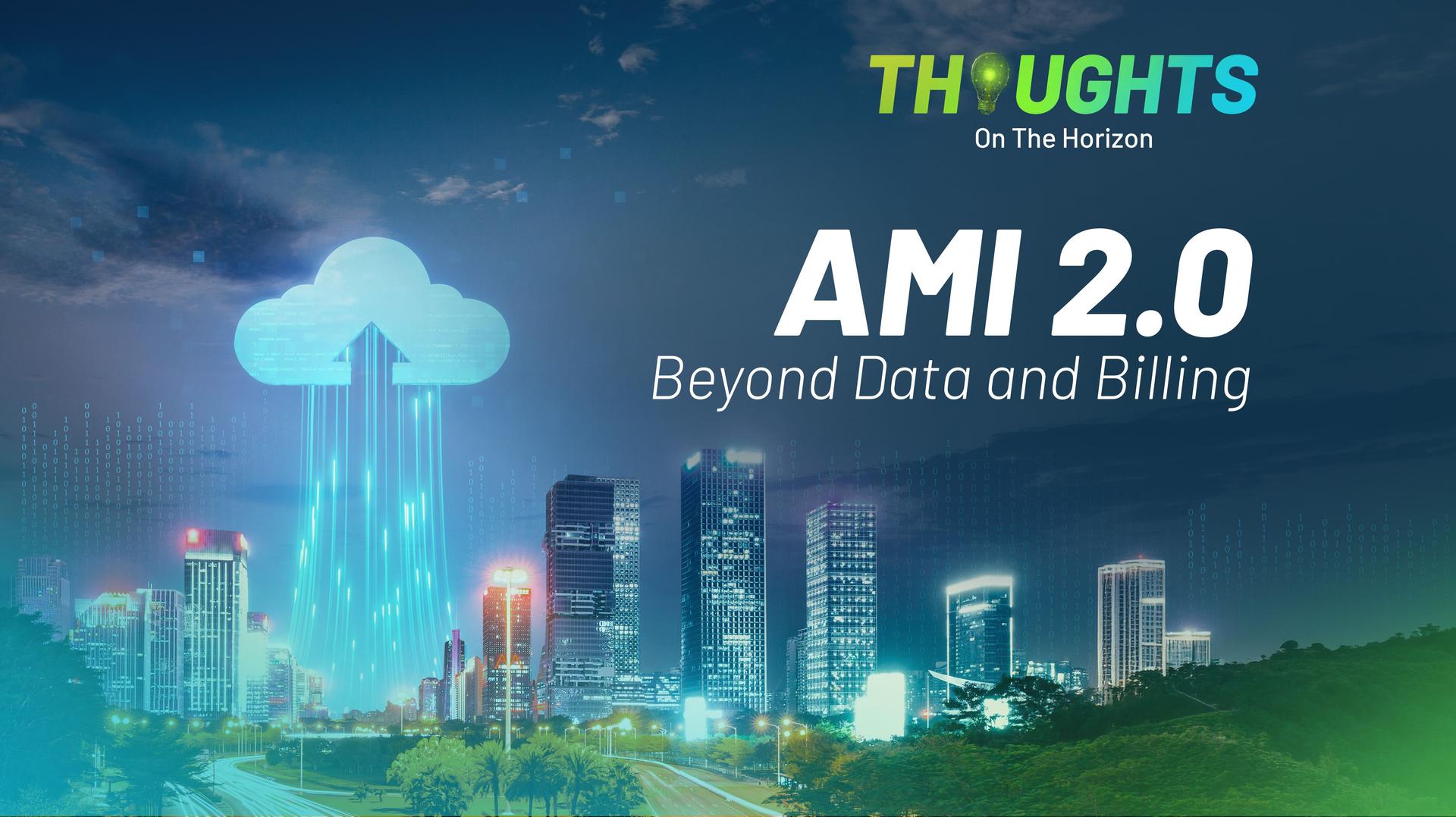
Why do we say Advanced Metering Infrastructure (AMI) 2.0 goes beyond interval and billing?
Part 1 of 3 Realizing the Full Value of the Grid-Edge Computing Platform Amit Golhani, Director Research and Development, Esyasoft
For two decades, the smart meter was the utility industry’s most visible symbol of grid modernization- and its most underutilized asset. AMI 1.0 delivered real value: reliably data collection to support meter-to-cash process, remote disconnect to reduce operation cost, and theft identification based on interval data patterns. What it did not deliver was transformation.
Advanced Metering Infrastructure 2.0 (AMI 2.0) represents a fundamental paradigm shift from a passive, telemetry-based billing system to an active, software-defined grid-edge computing platform. First-generation smart meters (AMI 1.0) focused primarily on automated meter reading, cumulative interval data collection, remote disconnect, and basic “last gasp” outage notifications, AMI 2.0 introduces something categorically different: a dense, distributed network of intelligent sensors capable of high-resolution waveform sampling and sub-second local processing.
This transition changes the fundamental granularity of data - shifting from legacy 15-to-60-minute interval batch telemetry to sub-minute, continuous streams of electrical parameters, event logs, power quality signatures. The structural transformation can be summarized in a single idea: AMI 2.0 looks both ways across the meter. The smart meter that once simply recorded consumption now simultaneously analyzes behind-the-meter consumer dynamics and front-of-the-meter grid behaviors.
Equipped with high-resolution sampling engines operating at frequencies up to several kHz, AMI 2.0 meters process electrical signal locally via embedded machine learning models. This localized processing extracts actionable operational intelligence at the source, rather than burdening backhaul communications networks and centralized cloud servers. By dissolving the historical boundary between utility operations and consumer-side activity, AMI 2.0 transforms every endpoint into autonomous, localized decision nodes - capable of grid optimization, asset protection, and rapid fault isolation.
AMI 2.0 is categorically different technology with categorically different ambition. Combined with software-defined-metering architecture- made possible by advances in embedded technology that let smart meters to evolve the way smartphones do- AMI 2.0 provides the operational foundation to move utilities from selling electricity to delivering Energy as a Service (EaaS).
So the question is - What Actually Changed?
At its core, AMI 2.0 is an edge-computing platform deployed at distribution scale. These meters capture voltage, current, power quality, and load data at sub-second sampling rates-continuously, not periodically. They embed AI inference engines capable of running load disaggregation algorithms that detect individual appliance signature without additional sensors. They communicate bidirectionally across multiple protocols- RF mesh, PLC, Cellular -and crucially, they accept over-the-air application updates the way a smartphone accepts app installs. This last capability-software-defined metering is the inflection point. A utility no longer needs to physically swap hardware to add a new use case. A demand response application, a real-time pricing engine, a DER coordination module all can be pushed to millions of endpoints from the operations center as new grid requirements emerge. The meter becomes a managed, programmable node: not a fixed instrument but a living service layer at the grid edge.
This means AMI2.0 investment are future-proof and follows the concept of product that grows.
Ultimately, AMI 2.0 is a categorically different technology with a categorically different ambition: turning every endpoint into an autonomous decision node. This software-defined foundation is what will allow utilities to transition from simply selling electrons to delivering dynamic Energy as a Service (EaaS).
**But what does this look like on the ground? ** In next week’s article, we will move from theory to application, diving deep into the core use cases including Distributed Energy Resources (DERs), Battery Energy Storage Systems (BESS), and EV infrastructure that prove how edge intelligence completely transforms asset orchestration.