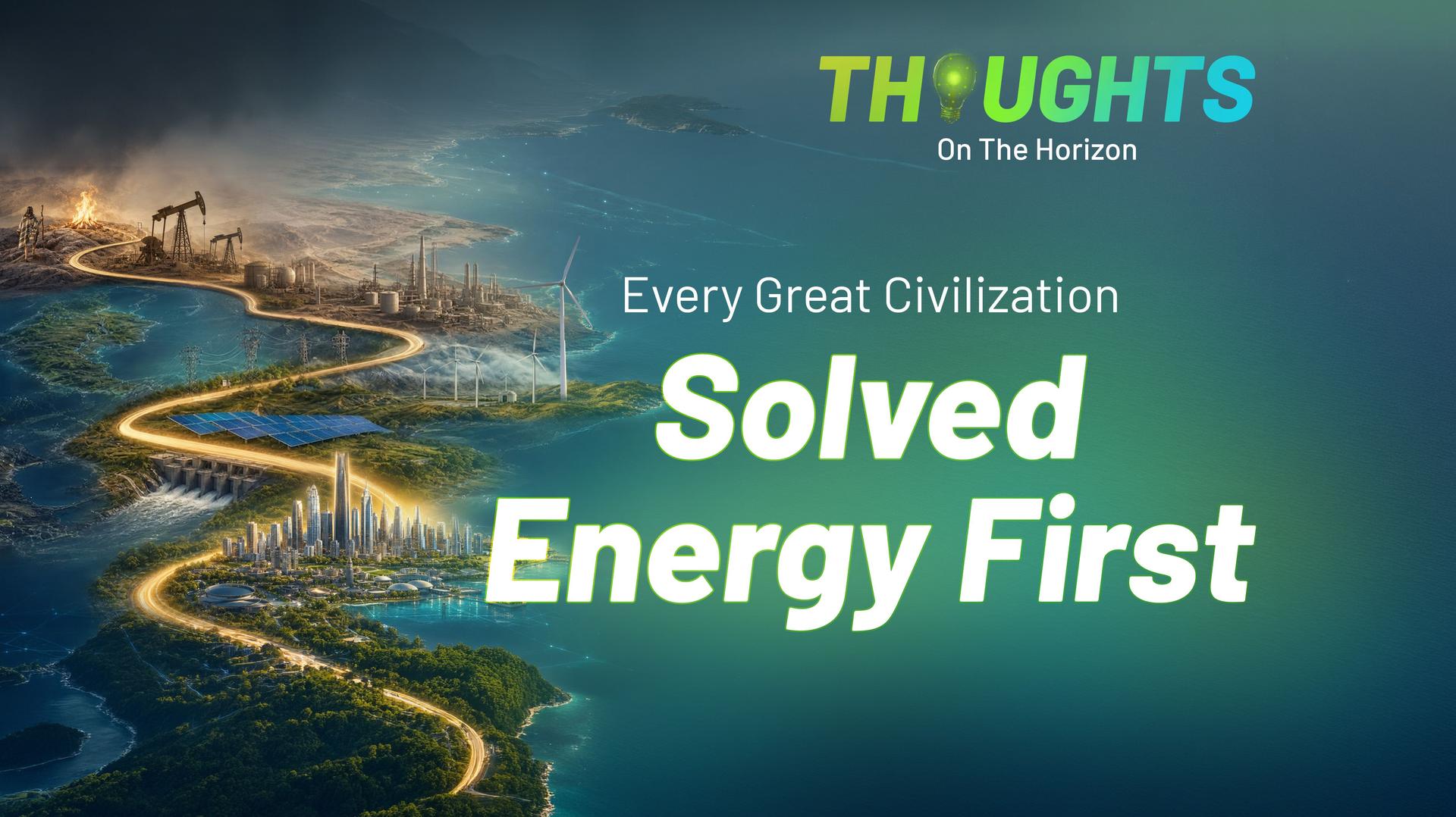
Every Great Civilization Solved Energy First
Maham Malik, Business Development & Strategy Manager, Esyasoft
Imagine a tribe discovering fire for the first time.
For hundreds of thousands of years, night had belonged to predators. Food was eaten raw. Cold was a fact of life. Then, one evening, somebody learned how to make a flame. The tribe gathered around it in disbelief. Warmth. Light. Protection. Cooked food. And then, inevitably, someone might have asked:
“This is impressive. But do we really have the budget for it?”
The joke works because it feels familiar. Across history, nearly every major energy transition has been greeted with some version of the same argument: too expensive, too risky, too early. Yet civilizations rarely rise because they optimize for the present. They rise because they invest in the systems that make a larger future possible.
Energy has always been one of those systems.
In a recent address at the prestigious conference Make it in the Emirates, held in Abu Dhabi UAE, I briefly touched on how historical shocks forced societies to rethink energy. What struck me afterwards was that the technology itself was rarely the hardest part. The larger obstacle was usually conviction. Someone always had to answer the same question:
Why should we invest in this new idea when the old system still works?
History's answer is surprisingly consistent. The civilizations that solved energy first usually shaped the future. The ones that hesitated often inherited it from someone else.
Fire, Water and the First Infrastructure Projects
Long before oil wells, power stations or smart grids, civilizations built energy systems around the resources it could control. The Persians constructed vast Qanat networks to move water across arid landscapes. The Romans built aqueducts capable of supplying entire cities. The Falaj systems of Oman distributed water through the desert with a level of engineering precision that still commands respect today.
We often remember these structures as feats of civil engineering. In reality, they were energy infrastructure. They enabled agriculture, trade, population growth and political stability. They transformed scattered communities into durable civilizations.
Then came a familiar problem: growth.
By the sixteenth century, Britain faced an energy constraint. Wood was becoming scarce. Prices climbed. Industries that depended on heat found themselves limited not by demand or capital, but by fuel. Coal offered an answer.
Few people liked it. It was dirty, smoky and unpopular. Established interests fought it. Consumers resisted it. Yet necessity has a way of overruling preference. Coal scaled. And once it scaled, everything else followed. Steam engines, railways, factories and eventually the Industrial Revolution emerged from that decision.
The lesson was simple: when a society reaches the limits of its energy system, the future belongs to whoever builds the next one.
The Journey to the Modern Grid
By the late nineteenth century, electricity existed. The real challenge was distribution.
Thomas Edison's Pearl Street Station in New York represented a remarkable achievement. Yet his direct-current (DC) system could only travel short distances before becoming economically impractical. Nikola Tesla and George Westinghouse proposed something different. Alternating current (AC) could travel much farther and serve much larger networks. What followed was not simply a technical debate. It was a struggle over business models, infrastructure and power. AC became the backbone of modern electrification. But the deeper lesson is more interesting.
Today, solar panels generate DC. Batteries store DC. Electric vehicles operate on DC. Data centres increasingly rely on DC internally. High-voltage direct-current transmission is becoming critical for long-distance energy transport. The question was never AC or DC. The question was what combination of technologies best served the needs of a particular era. The same principle applies today.
Oil and the Age of Geopolitics
Oil followed a similar path. When Edwin Drake drilled the first commercial oil well in Pennsylvania in 1859, few could have predicted how profoundly it would reshape the world. For a time, oil was simply another commodity. Then came the internal combustion engine. Suddenly oil was not merely fuel. It became mobility, manufacturing, logistics and military power. By the 1970s, energy had evolved into geopolitical leverage. The oil embargo demonstrated something policymakers already suspected but had not fully experienced: control over energy means influence over economics, diplomacy and security. Entire national strategies were redesigned around this reality. Energy was no longer a sector. It was the operating system beneath every sector.
The Transition Unlike Any Before
Every previous energy transition was driven by a familiar challenge: humanity needed more energy. That challenge has not disappeared. It is accelerating. Artificial intelligence, hyperscale data centres, electric vehicles, advanced manufacturing, and the electrification of transport and industry are driving a new surge in demand. Throughout history, energy consumption has moved in only one direction: upward. Every generation has been forced to find new ways of producing, distributing, and managing more energy than the one before it. What makes the current transition different is that for the first time in history, we are trying to satisfy that growing demand while also reducing the environmental impact of how energy is produced and consumed.
This is why unprecedented levels of investment are flowing into renewable generation, battery energy storage systems, grid modernisation, electrification, and digital energy infrastructure. The world is not merely building new sources of energy. It is rebuilding the architecture through which energy is generated, stored, distributed, and managed.
And unlike previous transitions, the defining infrastructure is not only physical, it is digital.
Modern energy systems require intelligence at every layer. Renewable generation must be balanced with demand. Storage systems must respond in real time. Electric vehicles are becoming both consumers and potential suppliers of energy. Data centres are emerging as major loads on national grids. The complexity of the system is increasing faster than at any point in energy history.
This is where technologies such as smart metering, grid analytics, utility software platforms, energy storage systems, and AI-driven network management become critical. They are not separate innovations. They are parts of the same intelligence layer that allows an increasingly distributed and dynamic energy system to function efficiently.
Like lesson learned from the famous battle between AC and DC, we are approaching a similar realisation today. The future is unlikely to be a simple story of oil versus renewables. Different energy sources will continue to play important roles across industries, geographies, and stages of economic development. The real objective is not choosing one side over another. It is building an energy system capable of supporting unprecedented growth in demand while becoming cleaner, smarter, and more resilient.
The Pattern Never Really Changes
Across thousands of years, the story remains remarkably consistent. The Persians invested in water networks. Industrial Britain invested in coal. The modern world invested in electricity. The twentieth century invested in oil.
Today we are investing in intelligent, digital energy systems.
Every transition appeared expensive. Every transition seemed risky. Every transition faced resistance and every transition eventually looked obvious in hindsight post its phenomenal success. The civilizations that prospered were not necessarily the ones with the most resources. They were the ones willing to build the infrastructure of the future before the future arrived.
At Esyasoft we believe energy transition is inevitably the way forward and are committed to make it happen!